CANADA MAKES RURAL IMMIGRATION PROGRAM PERMANENT: NEW PATHWAY TO PR OPENS JANUARY 2027
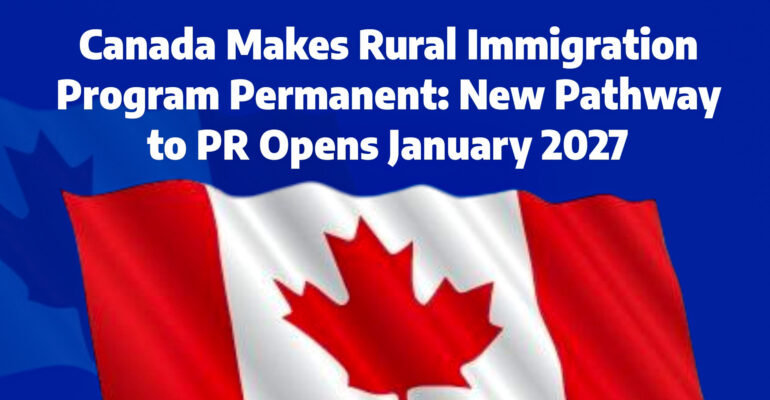

CANADA MAKES RURAL IMMIGRATION PROGRAM PERMANENT: NEW PATHWAY TO PR OPENS JANUARY 2027
Canada has officially made its Rural Community Immigration Program (RCIP) permanent, creating a long-term pathway to Canadian permanent residence for skilled foreign workers willing to live and work in smaller Canadian communities. The new permanent program will officially open on January 1, 2027, following the federal government’s decision to transition from the temporary Rural Community Immigration Pilot (RCIP).
The announcement was made by Immigration Minister Lena Metlege Diab on November 9, 2026, in Pictou County, Nova Scotia.
The decision is welcome news for foreign workers, international graduates and Canadian employers, particularly those outside major metropolitan areas who continue to experience labour shortages.
Under the permanent program, participating rural communities will continue to identify their labour market needs, work with designated employers and recommend eligible foreign workers for permanent residence.
The federal government also plans to expand the program to additional communities in the future, although the criteria and timeline for expansion have not yet been announced.
For prospective immigrants looking to move to Canada, the permanent rural immigration pathway could provide another opportunity to obtain Canadian permanent residence without relying exclusively on Express Entry or provincial nomination programs.
When Will Canada’s Permanent Rural Immigration Program Open?
Immigration, Refugees and Citizenship Canada (IRCC) has confirmed that the permanent Rural Community Immigration Program will begin accepting applications and community recommendations on January 1, 2027.
The new program will replace the temporary Rural Community Immigration Pilot, which was introduced to help smaller Canadian communities attract and retain foreign workers in occupations experiencing persistent labour shortages.
Unlike traditional immigration pathways that primarily rely on federal selection criteria or provincial nomination, the rural immigration program places considerable responsibility on participating communities and their designated employers.
The process generally involves:
- Participating communities identifying their local labour market needs.
- Employers receiving designation to recruit eligible foreign workers.
- Employers offering qualifying employment opportunities.
- Communities reviewing candidates and issuing recommendation certificates.
- Successful candidates submitting permanent residence applications to IRCC.
Although the program is now permanent, applicants must still meet the relevant federal eligibility requirements and the specific conditions established by their participating community.
What Happens to Existing Rural Community Immigration Pilot Applicants?
The transition from the temporary pilot to the permanent program is particularly important for individuals who already have a recommendation certificate under the existing Rural Community Immigration Pilot.
According to IRCC’s updated transition instructions, the pilot will close on January 1, 2027.
However, individuals who already received a valid community recommendation under the pilot will have an opportunity to complete their permanent residence applications, subject to the applicable validity periods.
Here is what existing applicants need to know:
- Candidates with recommendation certificates issued on or before December 31, 2026, must submit their permanent residence applications before their individual certificates expire.
- IRCC will continue processing permanent residence applications already received under the pilot.
- Existing pilot recommendations will be accommodated under the transition arrangements, with the relevant ministerial instructions remaining in force until June 30, 2027.
- Applicants who have not obtained a recommendation certificate under the pilot will need to follow the new permanent program.
Applicants should pay close attention to the expiry date printed on their individual recommendation certificates rather than assume that every applicant automatically has until June 30, 2027.
Eligible candidates may also qualify for a work permit while their permanent residence applications are being processed.
14 Canadian Communities Expected to Participate in the Permanent Rural Immigration Program
One of the most important aspects of the new announcement is the government’s intention to continue with the 14 communities currently participating in the Rural Community Immigration Pilot.
These communities are located across several Canadian provinces and offer potential employment opportunities in sectors experiencing labour shortages.
The 14 participating communities are:
| Province | Participating communities |
| Nova Scotia | Pictou County |
| Ontario | North Bay, Sudbury, Timmins, Sault Ste. Marie and Thunder Bay |
| Manitoba | Steinbach, Altona/Rhineland and Brandon |
| Saskatchewan | Moose Jaw |
| Alberta | Claresholm |
| British Columbia | West Kootenay, North Okanagan Shuswap and Peace Liard |
Each participating community has its own economic priorities, designated employers, eligible occupations and recruitment requirements.
This means that a job opportunity available in one community may not necessarily qualify under another community’s immigration priorities.
Foreign workers interested in the program should consult the official IRCC community directory to identify participating communities, their designated employers and current employment opportunities.
The federal government has also indicated that additional communities could join the permanent program in the future. However, no additional communities have been confirmed as part of the November 9 announcement.
Who Is Eligible for Canada’s Rural Community Immigration Program?
The permanent Rural Community Immigration Program is designed to attract skilled workers who can fill genuine employment needs in participating communities.
To qualify, applicants generally need to meet the following requirements:
1. Obtain a valid job offer
Applicants must secure an eligible job offer from an employer designated by a participating rural community.
The employment opportunity must meet the program’s requirements and align with the community’s local labour market priorities.
2. Obtain a community recommendation certificate
A recommendation from a participating community is mandatory.
The designated employer initiates the recommendation process, after which the community assesses the candidate and the employment opportunity.
3. Have relevant work experience
Most applicants must have at least one year of relevant work experience, equivalent to 1,560 hours, within the three years preceding their application.
Certain eligible international graduates may qualify for an exemption from this requirement.
4. Meet the language requirements
Applicants must demonstrate proficiency in English or French through an approved language test.
The minimum language requirement depends on the National Occupational Classification (NOC) TEER category of the job offer.
5. Meet the education requirements
Applicants must have a Canadian educational credential or an eligible foreign educational equivalent.
Foreign educational qualifications may require an Educational Credential Assessment (ECA), where applicable.
6. Demonstrate settlement funds where required
Applicants may be required to provide proof that they have sufficient funds to support themselves and accompanying family members after arriving in Canada.
However, certain applicants already working in Canada with a valid work permit are exempt from the settlement funds requirement.
Meeting these requirements does not automatically guarantee permanent residence. Applicants must also satisfy the applicable community-specific and federal immigration criteria.
Canada Rural Immigration Program: Minimum Language Requirements
One advantage of the Rural Community Immigration Program is that its minimum language requirements vary according to the skill level of the employment opportunity.
Applicants do not necessarily need the same English or French proficiency required under some other Canadian economic immigration pathways.
The minimum requirements are as follows:
| Job offers TEER category | Minimum language requirement |
| TEER 0 and TEER 1 | CLB/NCLC 6 |
| TEER 2 and TEER 3 | CLB/NCLC 5 |
| TEER 4 and TEER 5 | CLB/NCLC 4 |
Applicants must meet the required language level in all four abilities:
- Reading
- Writing
- Listening
- Speaking
Language test results must be less than two years old when the application is submitted.This flexible language structure could make the program an attractive option for foreign workers who have relevant professional experience but may not meet the higher language requirements associated with other immigration programs.
How to Get a Job Offer Through the Rural Community Immigration Program
Obtaining a qualifying job offer is one of the most important steps in the rural immigration process.
However, not every employer operating in a participating community is automatically eligible to recruit foreign workers through the program.
Employers must first receive official designation from the relevant community.
Once designated, an employer can recruit eligible candidates for positions that address the community’s labour market needs.
The employer then submits the candidate’s recommendation application to the participating community.
The community assesses the employment opportunity, the employer’s eligibility, the candidate’s qualifications and the alignment of the position with its local priorities.
If approved, the candidate receives a community recommendation certificate and can proceed with the permanent residence application.
Foreign workers should therefore verify an employer’s designation status before investing time and money in a recruitment process.
Applicants should also be cautious of individuals or agencies promising guaranteed jobs, community recommendations or permanent residence approvals in exchange for payment.
Can You Apply for Canada’s Rural Immigration Program From Outside Canada?
Yes. The permanent Rural Community Immigration Program is not restricted to individuals who are already living or working in Canada.
Foreign nationals residing outside Canada may qualify, provided they obtain an eligible job offer from a designated employer, receive a recommendation from a participating community and satisfy the applicable immigration requirements.
This means that skilled workers living in countries such as Nigeria, Ghana, India, the Philippines and other parts of the world may explore the program as a potential pathway to Canadian permanent residence.However, securing employment remains a critical requirement. Applicants cannot simply select a rural community and apply for permanent residence without first obtaining the required employment offer and community recommendation.
Can International Students in Canada Qualify Without One Year of Work Experience?
Yes, certain international graduates may qualify for an exemption from the one-year work experience requirement.
However, the exemption is not available to every international student who graduates from a Canadian institution.
Eligible graduates must satisfy specific conditions relating to their educational institution, program of study, graduation period and residence in the recommending community.
In general, the exemption is intended for eligible graduates of public post-secondary institutions located in the participating community.
International students interested in this option should carefully review the official IRCC exemption requirements before assuming that their Canadian education automatically qualifies them.
Can You Get a Canadian Work Permit While Waiting for Permanent Residence?
Yes. Eligible applicants under the permanent Rural Community Immigration Program may qualify for an employer-specific work permit valid for up to two years while their permanent residence applications are being processed.
This can allow successful candidates to begin working for their designated employer in the participating community while awaiting a final decision on their permanent residence applications.
However, submitting a permanent residence application does not automatically grant permission to work in Canada.
Applicants must separately satisfy the applicable work permit requirements.
Can Your Spouse Also Get a Work Permit?
Yes. IRCC has also provided for eligible spouses or common-law partners to apply for an open work permit alongside the principal applicant’s application for the two-year work permit.An important condition is that the spouse’s employment authorization is restricted to the same participating community as the principal applicant.
This arrangement can help families relocate together and establish themselves in smaller Canadian communities while their permanent residence applications are being processed.
How Much Money Do You Need to Immigrate Through the Rural Community Immigration Program?
Applicants may be required to demonstrate that they have sufficient settlement funds to support themselves and their accompanying family members when they arrive in Canada.
The amount required depends on family size and the applicable IRCC settlement funds requirements.
However, applicants who are already working in Canada with a valid work permit are exempt from demonstrating settlement funds under the program’s requirements.
Other applicants should consult IRCC’s official settlement funds table to determine the amount applicable to their family circumstances.
Canada Announces Rural Immigration Targets for 2027, 2028 and 2029
The decision to make the Rural Community Immigration Program permanent is supported by Canada’s 2027–2029 Immigration Levels Plan.
The federal government has introduced a separate admissions category for the rural immigration pathway, demonstrating its intention to maintain rural economic immigration as part of Canada’s long-term immigration strategy.
The published permanent residence admissions targets are:
| Year | Rural immigration admissions target |
| 2027 | 5,500 |
| 2028 | 6,000 |
| 2029 | 6,500 |
These figures represent planned permanent resident admissions rather than the number of new applications that will be accepted or the number of recommendation certificates available.The targets also include remaining admissions under the previous Rural Community Immigration Pilot and Rural and Northern Immigration Pilot, alongside future admissions under the permanent program.
Canada’s overall permanent resident admissions target remains 380,000 annually under the published plan.
What Does the Permanent Rural Immigration Program Mean for Foreign Workers?
The transition from a temporary pilot to a permanent immigration program represents an important development for Canada’s regional economic immigration strategy.
For foreign workers, it provides greater long-term certainty that rural immigration will remain an established pathway within Canada’s immigration system.
It also creates opportunities for individuals who may not have competitive Express Entry scores but possess the skills and experience needed by employers in smaller Canadian communities.
For international graduates, the program may provide another route to permanent residence, particularly for those who studied and established themselves in participating communities and qualify for the work experience exemption.
For Canadian employers, the permanent program provides a continuing mechanism to address labour shortages through international recruitment.
Nevertheless, prospective applicants should understand that the program is employer-driven and community-specific. Obtaining a job offer alone does not guarantee a community recommendation or permanent residence approval.
Frequently Asked Questions About Canada’s Rural Community Immigration Program
1. When does Canada’s permanent Rural Community Immigration Program start?
The permanent program is scheduled to open on January 1, 2027.
2. Is the Rural Community Immigration Pilot becoming permanent?
Yes. The federal government has confirmed the transition from the temporary Rural Community Immigration Pilot to the permanent Rural Community Immigration Program.
3. Can Nigerians apply for the Rural Community Immigration Program?
Yes. Nigerian nationals can apply if they secure an eligible job offer from a designated employer in a participating community, obtain a community recommendation and meet all applicable immigration requirements.
4. Can I apply without a job offer?
No. An eligible job offer from a designated employer is one of the central requirements of the program.
5. Do I need IELTS to qualify?
Applicants must demonstrate English or French proficiency through an approved language test. The required minimum level depends on the TEER category of the job offer. IELTS General Training is one possible English language test, but other approved tests may also be accepted.
6. Can I apply for permanent residence from Nigeria or another country?
Yes. The program is open to eligible foreign workers outside Canada as well as those already in Canada.
7. Can my family accompany me to Canada?
Eligible family members may accompany the principal applicant, subject to applicable immigration requirements. Eligible spouses or common-law partners may also qualify for an open work permit under the program’s provisions.
8. Can I work in Canada while my permanent residence application is being processed?
Eligible applicants may qualify for an employer-specific work permit valid for up to two years. A separate work permit approval is required before beginning employment.
9. Which Canadian provinces participate in the permanent rural immigration program?
The 14 communities expected to continue are located in Nova Scotia, Ontario, Manitoba, Saskatchewan, Alberta and British Columbia.
10. Will Canada add more communities to the program?Yes. The federal government intends to expand participation to additional communities in the future. However, further details and eligibility criteria for expansion are yet to be announced.
Final Thoughts: Is Canada’s Rural Immigration Program Worth Considering?
Canada’s decision to make the Rural Community Immigration Program permanent provides another opportunity for skilled foreign workers seeking Canadian permanent residence.
With its focus on employer-sponsored recruitment, community recommendations and regional labour shortages, the program could become an important alternative for eligible applicants who may not qualify under more competitive immigration pathways.
The January 1, 2027, opening date also gives prospective applicants an opportunity to research participating communities, identify designated employers, prepare their educational documents and complete the required language tests.
Thinking about moving to Canada? Our team at Absolute Destinations Limited are available to support you every step of the way.